
Façade Consultant: FMDC Ltd
Client: Argent (King's Kross Central Limited Partnership)
Architect: Alison Brooks Architects
Façade Contractor: Explore Industries (LOR)
Image Credits: Felix Cruz Marcos
Cadence is a landmark mixed-use building within the King’s Cross Central Masterplan, one of Europe’s largest urban regeneration projects. With its unique position framing the axis of Lewis Cubitt Park and its idiosyncratic arched language, this quietly flamboyant ‘courtyard tower’ celebrates the concept of threshold while reinforcing King’s Cross’ sense of place. Comprising 113 dwellings and 50 affordable apartments above two stories of commercial and service spaces, Cadence is recognized as one of King’s Cross most memorable buildings and a demonstration project for offsite manufacturing techniques.
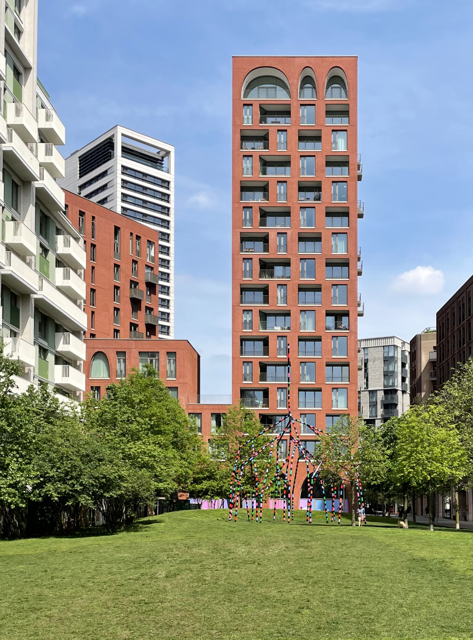
The project was Designed for Manufacture and Assembly (DfMA) and constructed utilising advanced prefabrication techniques. It features advanced prefabrication techniques such as precast columns, steel delta beams and hollow core slabs for the horizontal structure and façade precast panels, resulting in reduced waste, carbon emissions, and construction time while improving the building's thermal and acoustic performance.
The project utilised precast panels to accommodate a tight construction schedule, ensuring high-quality execution particularly for critical features like the ground floor and crown arches. The design maximised repetition to optimize costs and allowed for reusable formwork, while the hand-made bricks used were split in two, to cover twice the area. Orthogonal “doughnut” panels facilitated factory installation and sealing of the windows. The irregular pattern of openings on the façade repeats every two floors, allowing for increased repetition on the residential floors. This brought cost efficiencies that helped offset the impact of the base and crown arches. Timber composite windows were chosen above the ground floor to enhance thermal performance and lower carbon impact, utilising annealed laminated double-glazed units for further cost reduction after analysis discounted thermal shock risk.
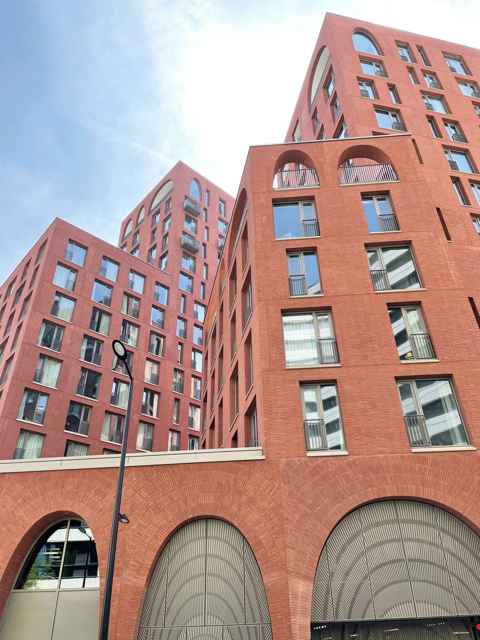
A key design challenge included constructing numerous double-height brick arches of different heights and widths with contemporary Bezier curves and a complex radiating brick pattern, all within budget constraints using handcrafted bricks – unifying building craft and digital technology.
An integrated approach was selected to meet this challenge, with a full parametric model of the arches and bricks created by ABA in Stage 3 using a Grasshopper Script, which was then integrated into a Rhino model. This model served as the foundation for detailed REVIT brick models within a federated model, as advocated by Laing O’Rourke’s Digital Strategy. This highly detailed model allowed the project team to discuss every interaction and potential clash between different façade elements in advance, resolving countless coordination problems, resulting in significant cost savings and reduced project timelines.
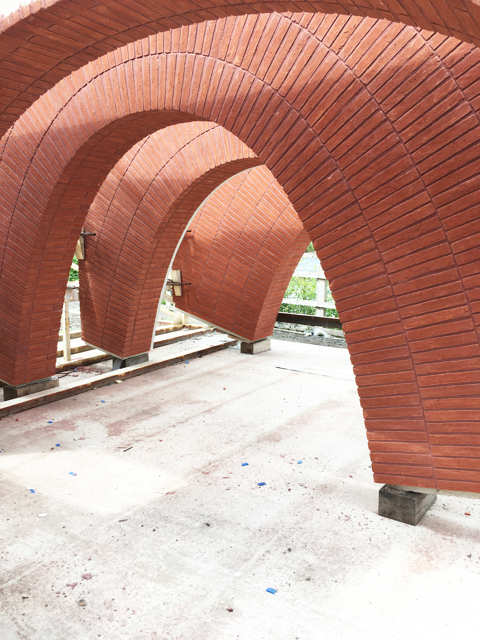
During the design process the geometry was further refined, simplifying the total 72 arches with varying Bezier curves into 36 different shapes, halving the total number of required precast moulds. Tapered mortar joints were utilized to avoid costly voussoirs, while hard joints and stacked lintel and leg panels enhanced the visual solidity of the double height arches.
The inclusion of mechanical ventilation and heat recovery (MVHR) units with the façade design involved integrating a plenum at the back of the precast panel and featuring a discreet linear slot discharging air just above the window frame. A design developed closely with ABA and Hoare Lea (MEP Engineers). Pre-glazed precast panels also ensured safety during the early fit-out phase, minimizing risks and limiting the need for external access to seal panel joints, via abseil.
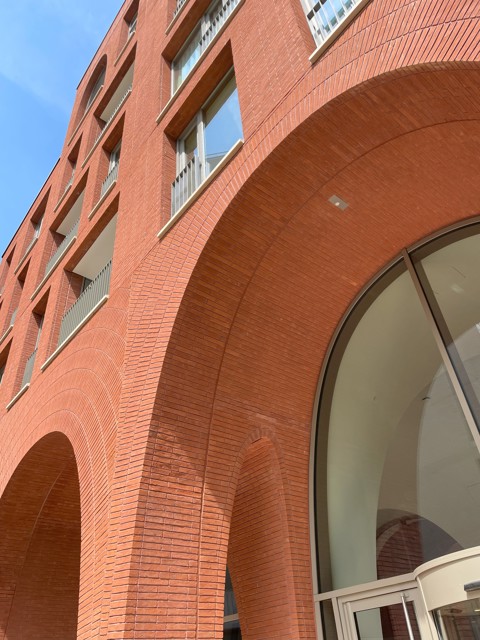
A holistic structural and energy approach was adopted which ultimately enabled rapid site assembly through a combination of a prefabricated structural frame and envelope. The precast envelope was erected ahead of the structural framework by four floors. This strategy facilitated early interior fit-out in a dry environment, significantly reducing program timelines and successfully delivering a complex and sculpted façade matching the architect’s vision.