
Part 1: RCG AGM and Annual Review (hosted by Darren Woolf)
The event opened with Darren Woolf setting the context for the Resilient Cities Group and the UK Urban Environmental Quality Partnership, explaining that the group is deliberately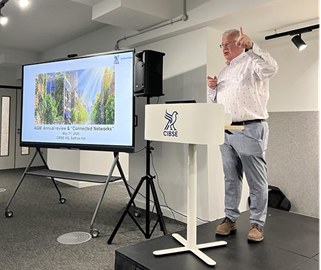 focused on collaboration across resilience, adaptation, climate action, and the urban environment. He emphasized that the purpose of the evening was not only to review the year but also to identify opportunities for joint work across overlapping networks, so that people are not “working on the same things at the same time in different networks.”
Darren outlined the current structure of the group, including the executive committee and the need to widen it with additional volunteers, particularly the group secretary, treasurer, and social media support roles. He also noted that LinkedIn had become the group’s main outward-facing channel. The AGM message was practical and slightly urgent: the group is active, but it needs more hands to sustain momentum and broaden its reach. If you would like to volunteer for any of these roles and join the RCG Executive Team which organize and guide the group, please send an email to [email protected] by the end of May 2026 with your interest or just for further information.
A large part of the review focused on the group’s recent themes and outputs. Darren highlighted events and publications on adaptive decarbonization, embedding climate resilience into your projects, the need for more ‘wicked’ and systems design skills in our community, regenerative design and, finally, setting the context for resilient cities. Across these topics, his central argument was that mitigation and adaptation are often treated as separate conversations, when in practice they should be integrated into one more resilient narrative.
He used examples such as trees, shading, and urban greening to show that the same intervention can produce very different outcomes depending on whether it is designed for carbon reduction, heat reduction, flood mitigation, or wider liveability. He also stressed that climate resilience is not just technical: it involves policy, design, benchmarking, accountability, and a stronger evidence base for how buildings and cities perform under stress.
Two RCG initiatives were discussed. The first, presented by Bahareh Salehi, was applying the UN Sustainable Development Goals to urban resilience solutions, with the aim of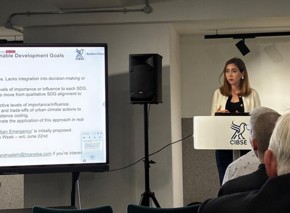 turning broad global goals into a practical framework engineers and consultants can use in day-to-day projects.
RCG also intend to host an event on this subject during the upcoming London Climate Week. If you’re interested in supporting this initiative, please send an email to [email protected] by the end of May 2026.
The second, presented by Darren Woolf, was a “Wicked Skills for Resilient Cities,” initiative which responds to the complexity of climate-related urban problems and the need for stronger systems thinking, better collaboration between academia and industry, with more accessible guidance for the industrial interface supporting a fast-track scaling up of the necessary skills for a more impactful climate action response. If you’re interested in supporting this initiative, please send an email to [email protected] by the end of May 2026.
Several ongoing UKUEQ initiatives were shared, including:
· A good-practice guide on wind compliance within UK cities following on from the City of London Guidance with additional updates in methodology. Presented by Rob Rowsell. Contact him at [email protected] if you’d like to support this initiative.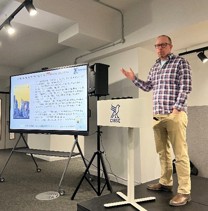
· Air quality guidance on selecting fit-for-purpose air quality models. Presented by Jenny Stocker. Contact her at [email protected] if you’d like to support this initiative.
· A consolidation of outdoor thermal comfort methods into guidance. Contact [email protected] if you’d like to support this initiative.
The overall picture was the group is moving from broad conversation into practical outputs, with publications, events, and guidance documents intended to help industry work more intelligently on urban resilience.
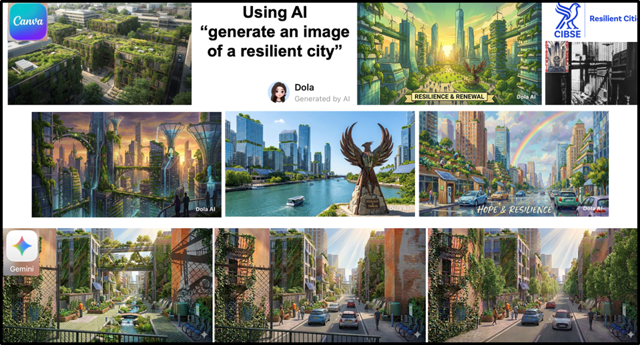
Before handing over to the networking event, Darren reflected on the idea of a resilient city through an AI-generated image exercise. His point was that even with multiple AI tools, no single visual consensus emerged on what a resilient city should look like, reinforcing the idea that the field itself is still defining its priorities. That led naturally into the second half of the evening: a more open, network-sharing session designed to connect people, ideas, and organizations.
To view the AGM and Annual Review click HERE
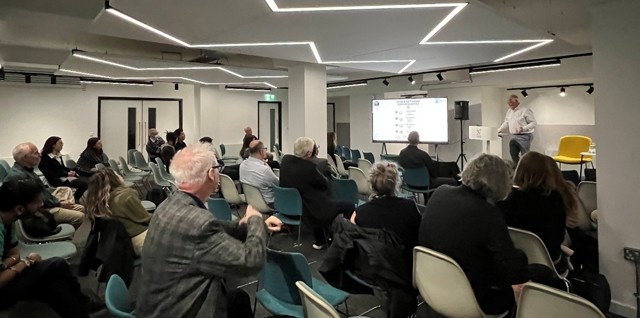
Part 2 Resilient Cities - Connected Networks (hosted by Paul Woodville)
Paul Woodville introduced the event as a deliberately open  conversation, with slide presentations first and then website-based introductions, all intended to encourage dialogue and future collaboration. The format was informal but purposeful: each network had a few minutes to explain what they do, followed by questions and connections across the room.
 Presented by Jenny Stocker, FAIRMODE is the Forum for Air Quality Modelling, bringing together modellers and users to support the harmonized use of models across EU member states in support of European Air Quality Directives. Its work centres on fit-for-purpose modelling, benchmarking, validation, uncertainty quantification, and capacity building through working groups, comparison exercises, and shared guidance.
FAIRMODE is organised through a roadmap that updates every three years, and participants can join the working groups most relevant to their interests, such as microscale assessment and planning, sensors and data fusion, and forecasting. The network combines technical rigour with practical policy relevance, especially now that the 2024 air quality directive makes model use more central to compliance.
Urban Fluid Mechanics SIG
 The Urban Fluid Mechanics Special Interest Group, introduced by Maarten van Reeuwijk (presentation by Zhengtong Xie), has been running for around seven or eight years and aims to balance the latest academic developments with active participation from industry and non-governmental organisations. It has over 250 people on its mailing list, has organised 13 workshops to date, and uses its events not just for talks but also for discussion, brainstorming, and identification of key research problems.
The group also maintains a website where people can join the mailing list, and it offers a data portal with curated datasets relevant to urban wind, air quality, and related applications. Its objective is essentially to connect research, data, and practice in a way that supports better urban fluid mechanics understanding and use.
UK Green Building Council
Clare Wilde presented the UK Green Building Council, a membership organisation with around 600 members across the built environment, focused on radically improving sustainability in the sector. Its climate resilience roadmap which include technical and policy reports, and GIS maps. UKGBC are also producing stakeholder action plans that define short-, medium-, and long-term actions for key stakeholder groups such as engineers, architects, consultants, and urban planners, which are currently open for consultation.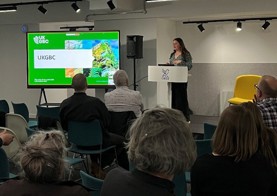
UKGBC has also created new member forums, including climate adaptation and resilience, resource use, and energy and carbon, with regular meetings across the year. In the discussion, Clare explained that many corporate and asset-owner members are beginning to take climate risks more seriously, especially around overheating and flood risk, but are still working out how to turn concern into practical action and board-level decision-making.
RIBA Climate Group
Julie Futcher introduced the emerging RIBA climate group and described her long-standing work connecting architecture and urban climatology. Her core message was that urban
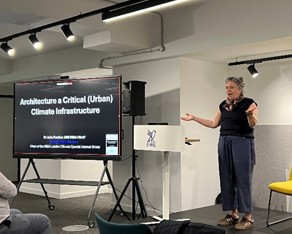
morphology and architectural decisions shape local climate conditions in profound ways, and that this is still under-recognised within built environment practice. She sees the group as a way to improve dissemination, shift professional understanding, and build a more climate-literate architectural culture.
A major part of her contribution was the role of urban climate walks, which the network uses as a practical, place-based way to discuss climate with professionals and the public. She described these walks as a tool for engagement, education, and public awareness, and noted that the network has run them globally, with future walks planned in several locations. The group’s objectives are strongly educational and civic: to make climate more tangible, local, and understandable through lived experience and shared observation.
UK Wind Engineering Society
Bernardo Vasquez, chair of the UK Wind Engineering Society, described the society’s collaboration with RCG and its role in several initiatives relevant to wind, trees, vegetation,
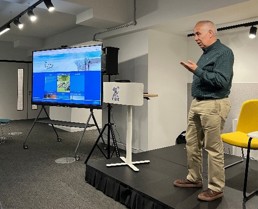
thermal effects, and CFD validation. He highlighted an ongoing exercise on testing and validation of CFD codes, plus a future-winds project examining how changing climate conditions may affect wind behaviour and related variables.
The Society’s activity is broad, covering anything related to wind, though not wind turbines, and it is also linked to publications arising from work with universities such as Birmingham and Reading. Its objectives are to advance wind engineering knowledge, support research-led guidance, and connect wind behaviour with wider resilience questions such as temperature and urban form.
UrbanAIR was presented by Maarten van Reeuwijk as a European project involving around 20 partners, including meteorological offices, measurement groups, and model builders. It is part of the EU’s Destination Earth initiative and aims to build digital twins
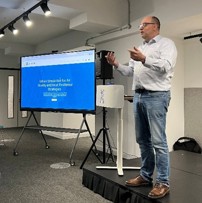
for cities, with three main prototype areas: green potential maps for urban greening, urban extremes to explore future extreme events, and a digital twin supporting the air quality directive.
The project is still early in development, but it is already carrying out a major intercomparison study focused on Paris and local microclimate modelling. Its objective is to help planners and researchers use digital tools to make better decisions about urban greening, extreme heat, and air quality under future climate conditions.
CIB and Intelligent Buildings
Shen Wei introduced two related networks: one under CIB, the International Council for Research and Innovation in Building and Construction, and another linked to the Wates Innovation Network (WIN) Portal. The CIB-related work focuses on intelligent and
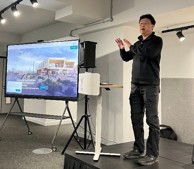
responsible buildings and the interaction between buildings and the local environment, while also connecting with academic publishing through the journal Intelligent Buildings International.
The WIN Portal was described as a free UK platform that links buyers and sellers of low-carbon technologies, with around 130 UK companies listed. Its role is to connect higher-level stakeholders with developers and SMEs, making it easier for the market to discover and access low-carbon solutions.
Why It Mattered
The strongest theme across Part 2 was that each network is tackling a different part of the resilience puzzle, but all of them share common needs: better data, clearer guidance, stronger collaboration, and more effective transfer between research and practice. The room was explicitly encouraged to use the evening to identify overlaps and potential partnerships rather than working in silos.
The event closed by reinforcing the importance of networks, LinkedIn visibility, and continued informal connection over food and drinks. The overall tone was constructive and collaborative: these organisations are not just talking about resilience, they are trying to build the professional relationships needed to make it happen.
To view the presentation of the AGM, Annual Review and “Connected Networks” event click HERE.