On 20 November 2025, as part of elementalLONDON, the session titled “Regenerative Design and Resilient Cities” brought together leading voices to explore how the built environment can move ‘beyond sustainability’ towards regeneration and resilience. Hosted by the CIBSE Resilient Cities Group, the event highlighted the urgent need for integrated approaches that combine climate adaptation, social equity, and systemic thinking.
The session featured insightful presentations from:
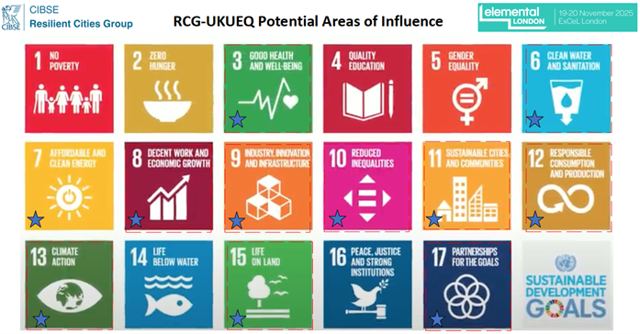
- Darren Woolf – Chair of the CIBSE Resilient Cities Group, who introduced the concept of regenerative design and its alignment with UN Sustainable Development Goals.
- Alice Poole – Associate Partner at PA Consulting, who shared a bold vision for regenerative futures, emphasising equity, education, and circularity.
- Julie Futcher – Architect and Chair of the North London RIBA Group, who examined urban morphology, microclimate effects, and the role of built form as climate infrastructure.
- George Adams – Former CIBSE President, who reflected on the societal and economic imperatives for resilience and the need for global collaboration.
This blog captures the key themes, challenges, and opportunities discussed during the session, offering practical insights for architects, engineers, planners, and policymakers committed to shaping cities that thrive in a changing climate.
Introducing Regenerative Design
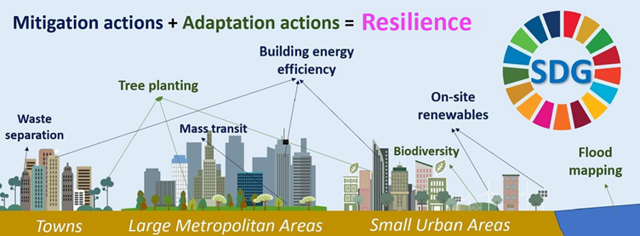
Darren opened the session by defining regenerative design as an approach that goes beyond current sustainability and net-zero targets. He explained that regenerative design focuses on creating systems where human and natural environments co-exist and evolve together. Darren highlighted the alignment of this concept with the UN Sustainable Development Goals and stressed the importance of systemic thinking in urban planning. He also shared the work of the CIBSE Resilient Cities Group, including a near-complete publication on ‘CFD modelling of urban vegetation systems’ and ‘adaptive decarbonisation’. His key message was clear: architecture must be treated as active climate infrastructure, not isolated energy islands.
A Vision for Regenerative Futures
Alice brought a bold perspective on why sustainability is no longer enough. She introduced PA Consulting’s Regenerative Futures Vision, which calls for restoring and replenishing the systems we depend on. Alice emphasised that regenerative design is not only about environmental restoration but also about social equity and economic opportunity. She discussed principles such as ecosystem enhancement, circularity, and prosperity, highlighting the need for job creation and education within communities. Alice illustrated her points with examples like the Appleby Blue Almshouse project and Victorian infrastructure, showing how design can address both environmental and social challenges. Her message: regeneration is ambitious, systemic, and deeply human.
Urban Morphology and Microclimate Challenges
Julie focused on the physical realities of resilience in dense urban environments. She explained that by 2050, 20% of the UK’s building stock will need to be constructed on just 1–3% of land, creating significant challenges for urban morphology. Julie explored how increasing density and tall buildings affect airflow, shading, and solar access, often undermining renewable energy strategies. She highlighted the science behind urban heat islands, noting that risks are driven by geometry and height-to-width ratios rather than population density. Her conclusion was that built form regulates urban climate, and therefore design must move beyond individual buildings to consider city-wide interdependencies.
The Global Imperative
George closed the session with a broader societal and economic perspective. He warned that climate change is not just a local issue but a global challenge requiring urgent investment and behavioural change. George highlighted the imbalance in spending—only 1% of global GDP goes to climate action compared to 2.5% on arms—and predicted severe economic consequences if action is delayed. He called for systemic shifts in consumption, reuse, and public engagement, stressing that resilience must extend beyond cities to include rural systems and food security. His message was clear: we have the knowledge and technology, but lack urgency and investment.
Questions & Answers
The Q&A session added depth to the discussion.
- A question was about storytelling and how to make climate resilience messaging more effective. Julie explained the importance of experiential learning through urban climate walks, which allow people to feel the impact of urban heat and density. George added that communication remains a major challenge, noting that society often fails to grasp the urgency of climate risks.
- Another question focused on simplifying technical language for public engagement. Alice suggested using relatable examples, such as insurance incentives for flood mitigation or practical measures during heatwaves, to make resilience tangible.
- Another question was about elaborating on the urban heat island effect and the rate of cooling. Julie clarified that the phenomenon is driven by geometry and shading, which affect heat retention and release. She stressed the need to integrate this knowledge into design practice and offered CPD sessions for those interested.
The session underscored a shared belief: resilience and regeneration demand collaboration across disciplines and sectors. From Darren’s need to generate an agreed framework for regenerative principles to Alice’s call for equity, Julie’s insights on urban morphology, and George’s global outlook, the discussion offered a roadmap for creating cities that are not only sustainable but truly regenerative.
The presentation slides can be found here providing additional detail and visual context for the ideas shared.
For those who could not attend, the full recording of the session can be found here, providing an opportunity to revisit the rich insights and practical strategies shared by the speakers.
The CIBSE Resilient Cities Group is committed to driving this agenda forward. We invite professionals, researchers, and community leaders to join us in shaping the future of resilient and regenerative urban environments. Your ideas, expertise, and passion can help accelerate change. Get involved, share your feedback, and collaborate with us. Together, we can create cities that thrive in a changing climate.
👉 Visit our website or connect with us on LinkedIn by scanning the barcode below to learn more and join the conversation.