
The Australian Government has just released their “Commercial Building Disclosure Program – Policy Roadmap” (https://www.cbd.gov.au/sites/default/files/2025-10/ENR325.0625%20CBD%20Roadmap%20v10.pdf) and as expected it lays out a plan to expand mandatory energy ratings to more building types — and to make those ratings a regular part of building operations.
For property and facilities managers, this means energy performance is no longer just a concern at the point of sale or lease. Instead, large office tenancies and hotels will soon be required to obtain and disclose NABERS energy ratings on a recurring basis — likely every one to three years. This shift is designed to give tenants and owners alike a clearer picture of how buildings are performing, and to drive improvements in energy efficiency.
Tenants in large office spaces (over 1000m² initially) will be brought into the fold, with new obligations to obtain NABERS tenancy ratings. Whilst some will no doubt object to this regulatory burden, such ratings will help tenants understand their own energy use and support them in their broader sustainability goals.
NABERS has a ‘co-assess’ process that allows owners and tenants to be rated together, making it easier and more cost-effective for tenants to comply, and for property managers this presents a good opportunity for greater tenant/owner collaboration.
Hotels are also in line for change. Large hotels (over 100 rooms) will need to disclose their NABERS hotel energy ratings — including how much of their energy comes from renewable sources. These ratings will be visible on hotel websites and booking platforms, helping guests and corporate clients make informed choices.
Other building types — including shopping centres, retail stores, aged care facilities, and warehouses — are being considered for future inclusion, and mixed-use buildings may no longer enjoy exemption status.
The roadmap outlines a staged rollout (see the graphic below), with legislative changes around hotels and tenancies expected in 2026/7, and disclosure expected prior to 2030.
Full implementation of the roadmap (medium- and longer-term sector expansion) is expected by 2035, though mixed-use exemption may be abolished much earlier.
It should be noted that the roadmap also canvasses the implementation of Minimum Energy Performance standards (MEPs). The roadmap is light on detail in this regard, but it is clear that Government will be looking to implement something sooner rather than later.
Energy performance disclosure is becoming a regular part of building management. Buildings caught up in the first round of mandatory disclosure are now enjoying significant energy savings, and there is no reason to expect that history won’t repeat itself. For property manager, tenants, and hotel managers, now is the time to get ahead of the curve.
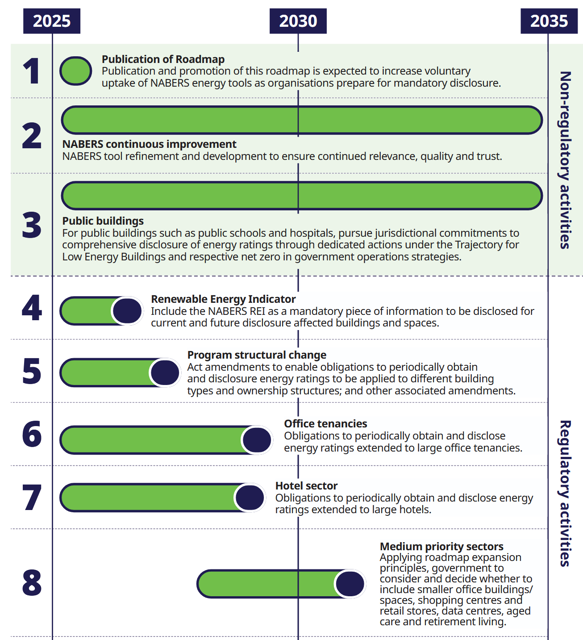
Image from Commercial Building Disclosure Program | Policy Roadmap
Figure 1: CBD Expansion roadmap