
The UK Net Zero Carbon Buildings Standard Version 1 (the Standard), published March 10th, robustly defines what a building needs to do to be Net Zero Carbon Aligned in the UK. The Standard’s limits are based on the UK’s carbon and energy budgets: all of its requirements must be met and verified to achieve conformity. Buildings that don’t meet all the requirements cannot claim to be Net Zero Carbon Aligned. Not all buildings will be able to meet the Standard straight away, so it is important to upskill the industry and support plans for buildings to conform in future: UKNZCBS Performance Evaluations have been created to address this need.
Recognising progress
The mission of the Standard is not just to create a definition, but also to drive market transformation towards net zero carbon and create consistency within the industry.
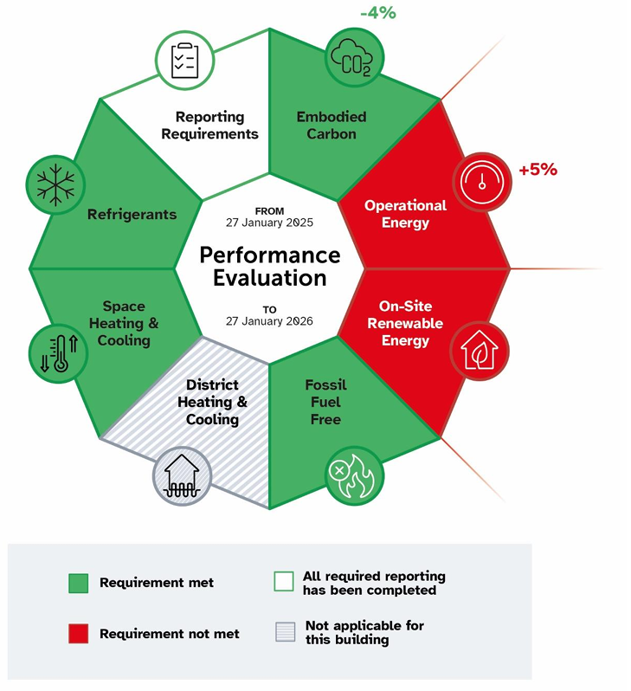
In pursuit of these goals, a separate Performance Evaluation designation is being introduced, allowing buildings to be evaluated against the Standard’s requirements, even if they are not meeting all of them. Launching at the same time as the Standard’s verification in Q2 this year, UK NZCBS Performance Evaluations will require the same level of verification as for a Net Zero Carbon Aligned claim, and the output will provide a robust indication of how the building is performing across different aspects of the Standard’s requirements.
While not the same status as being Net Zero Carbon Aligned, a verified Performance Evaluation acts as a “report card” for the building, using the same metrics and measurements. They also show how closely a building performed against the applicable limits in the Standard. This represents an important step on a building’s decarbonisation journey, both through reporting of in-use performance, and following the process: learning to measure and assess performance against the Standard, and to access and understand the relevant data.
Toward a Net Zero Carbon built environment in the UK
The intention of introducing Performance Evaluations is to support widespread adoption of the Standard, acting as a “building MOT” that shows where attention is needed to meet its requirements. They encourage transparency about building performance, provide a robust indicator of a building’s progress on the journey towards being Net Zero Carbon Aligned, and contribute to the evidence base that will inform the future development of the Standard.
Performance Evaluations are also a mechanism for industry-wide improvement. Every building that pursues a Performance Evaluation has gone through a data-gathering and measurement process with the Standard's requirements in mind. The more buildings that go through that process, the more the industry as a whole moves in the right direction — driving down carbon emissions and reinforcing the skills and knowledge needed to reach net zero.
David Partridge, Chair of the Governance Board of the UK Net Zero Carbon Buildings Standard: “Performance Evaluations will further drive market transformation towards achieving Net Zero Carbon by 2050, and will allow the Standard to be written into legal and regulatory processes. Now, contracts, and one day, regulations, can insist on buildings being verified, with the aim of achieving a Net Zero Carbon Aligned designation, and with the backstop of receiving a Performance Evaluation.. This will drive the industry towards adopting the Standard’s metrics, and towards a nationally consistent and transparent reporting methodology”.
Christopher Jockel - Associate Director - Corporate ESG, Bureau Veritas, and Bureau Veritas
/ UK NZCBS Verification Development Project Lead: “Bureau Veritas are used to working with verification clients on upfront methodology validations, pre-verification ‘readiness’ assessments and non-accredited benchmarking assessments against carbon, GHG and wider sustainability standards. So when UK NZCBS stakeholders called for something like, and what finally became, Performance Evaluations, we understood its value and supported the concept. We have since worked closely in partnership with the Standard to make Performance Evaluations a reality on the verification side, supporting wider engagement with the Standard. The rigour of the verification process for both Performance Evaluations and Net Zero Cabon Alignment will drive industry.”
Simon Wyatt – partner, global head of sustainability, Cundall and member of the BCO ESG Committee: “The introduction of the Performance Evaluation designation responds directly to industry concerns about the binary pass/fail approach to Net Zero Carbon Aligned status. By recognising projects that are making measurable progress, even if they have not yet met all criteria, this initiative encourages broader engagement with the Standard. BCO fully supports this approach and encourages office developers and owners to participate. We look forward to continuing our collaboration with the Standard to address our members’ concerns and to further drive adoption across the industry.”