
In the race to decarbonise the UK's built environment, achieving outstanding energy performance in existing buildings remains one of the industry's greatest challenges. Yet a 1970s office building in Sunbury-on-Thames has just set a new benchmark.
Building services and sustainability consultancy Watkins Payne’s office has become the first building in the UK to achieve a 6 Star NABERS UK Whole Building Energy Certified Performance rating, reaching the highest level of the operational energy performance scheme. This achievement follows two consecutive 5.5-star ratings, as reported in a February 2026 article in CIBSE Journal. and represents another significant milestone in the building's ongoing energy efficiency journey.
The result is particularly noteworthy because the building is neither a new development nor a purpose-built smart office. Instead, it demonstrates what can be achieved through a sustained commitment to improving building performance, targeted investment, careful energy management and the integration of renewable energy.
Administered in the UK by CIBSE Certification, a wholly owned subsidiary of CIBSE, NABERS UK provides an independent, evidence-based assessment of how buildings perform in operation, rather than relying solely on design intentions or predicted energy consumption. Watkins Payne's achievement is a powerful demonstration of the value of measuring, understanding and continually improving actual building performance.
A journey built on continuous improvement
Watkins Payne's journey towards the highest NABERS UK rating began in 2021, with a strategy focused on relatively straightforward interventions that could deliver meaningful energy savings without requiring major capital investment.
The initial improvements included replacing compact fluorescent lighting with high-efficiency LED fittings incorporating daylight dimming and occupancy sensors. Timers were also introduced on high-energy plant equipment, while staff engagement played an important role in changing everyday energy consumption habits. An internal HVAC Energy Champion helped colleagues make better use of heating, cooling and ventilation controls.
These measures enabled the building to achieve a 5.0 Star rating, recording an energy use intensity of 89.6 kWh.m⁻² for the period ending October 2023.
The next milestone was 5.5 Stars. To identify the improvements required, the consultancy used an advanced simulation model to understand where further savings could be made. One of the most significant interventions was replacing the building's original single-glazed windows with double-glazed units, reducing heat loss through the façade while improving occupant comfort and encouraging greater use of natural ventilation.
The heating strategy was also refined, particularly in restroom facilities, to minimise unnecessary out-of-hours energy consumption.
By November 2024, the building had achieved its 5.5 Star target, with a decimal tracking indicator of 5.51. A year later, it maintained its rating while improving its decimal tracking indicator to 5.65, demonstrating continued progress despite an increase in operational hours.
However, reaching 6 Stars would require a different approach.
Solar power unlocks the six-star milestone
With many of the building's straightforward energy-saving opportunities already addressed, Watkins Payne turned its attention to onsite renewable energy generation and more granular control of consumption.
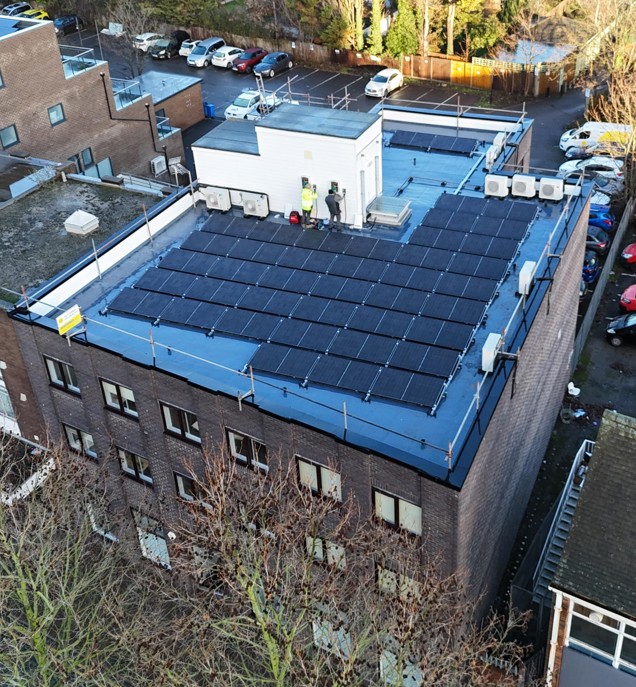
The installation of 41 solar photovoltaic panels on the roof, with a combined capacity of 21 kWp, became a central part of the strategy. Initially expected to generate approximately 13,075 kWh of electricity annually after losses, the installation was designed to make a substantial contribution to the building's energy requirements.
The latest results demonstrate the significance of this investment. Onsite solar generation has played a decisive role in enabling the building to achieve its 6 Star rating, with the installation now accounting for approximately 31% of the building's energy consumption.
This is particularly important under NABERS UK's Whole Building rating methodology, where renewable electricity generated and consumed onsite reduces the amount of electricity imported from the grid and therefore contributes directly to the building's certified energy performance.
The achievement illustrates how renewable generation, when combined with demand reduction and effective building management, can help existing buildings reach levels of operational performance that might previously have seemed out of reach.
A benchmark for the existing building stock
Watkins Payne's achievement carries important lessons for the wider industry. Existing buildings represent a significant proportion of the UK's building stock, and improving their operational performance will be essential to meeting national decarbonisation objectives. Yet retrofit discussions often focus on major interventions, extensive refurbishment or the replacement of entire building systems. The Sunbury office demonstrates a different approach. Its progress has been driven by a combination of targeted fabric improvements, efficient lighting, better controls, occupant engagement and, ultimately, onsite renewable energy generation. It also reinforces the importance of measuring actual performance. Through NABERS UK, Watkins Payne has been able to track its progress against independently verified operational energy benchmarks, identify opportunities for improvement and demonstrate the impact of its investment.
For CIBSE Certification, the first 6 Star NABERS UK achievement in the country represents an important milestone for the scheme and the growing focus on measured building performance. It demonstrates the value of independent certification in encouraging accountability, supporting continuous improvement and recognising buildings that deliver exceptional results in operation.
As the UK industry continues to address the challenge of decarbonising its existing building stock, Watkins Payne has set a new standard. Its journey from 5.0 to 6 Stars shows that high-performing buildings are not necessarily defined by when they were constructed, but by how effectively they are managed, improved and operated.