
Next dates:
Sydney - Australia
9:00 am - 5:00 pm
Wed, 25 Nov 2026
Register here
Online - ANZ
8:30 am - 4:30 pm, AEDT
Thu, 3 Dec 2026
Register here
*All online sessions are recorded, with access to the recordings granted for 30 days.
About this Course:
This course has been developed in conjunction with AHSCA QLD, CIBSE, HCAA and ICC.
This course equips hydraulic designers, engineers, plumbers, and regulators with the knowledge and skills needed to understand drainage system challenges in reactive and unstable soils and determine when specialist expertise is required.
This training establishes a practical and consistent framework for managing the challenges associated with soil movement and reactive ground conditions. It is designed to enhance participants’ understanding of current industry practices, emerging methodologies, and risk-based decision-making approaches that can help minimise reliance on performance solutions where appropriate.
While this course is not intended to be a definitive “fix-all” solution, it aims to provide valuable insights into the key considerations, principles, and requirements needed to support better outcomes across the industry. By increasing awareness and understanding, the course seeks to contribute to more informed decision-making and improved practice.
Who should attend:
This course is suited to those wishing to develop a practical understanding of drainage design considerations in reactive and unstable soils, improve their ability to identify potential risks and limitations of standard solutions, and better understand when specialist geotechnical or engineering input is required.
- Hydraulic consultants and designers
- Engineers and project managers
- Plumbing contractors
- Plumbing regulators, inspectors and certifiers
- TAFE instructors and vocational trainers
- Builders
- Architects
Learning outcomes:
On completion of this course you will have an understanding of the following:
- Understand reactive and unstable soil behaviour in drainage design
- Understand the requirements of the BCA, AS 2870, AS 2566.1 and interpret the requirements of the PCA and AS/NZS 3500 correctly for plumbing applications
- Understand what other experts are required to determine and develop the correct solution
- Identify when to use DTS solutions vs Performance Solutions
- Navigate jurisdictional differences and plumbing regulators' expectations
- Apply real-world design techniques through case studies and exercises
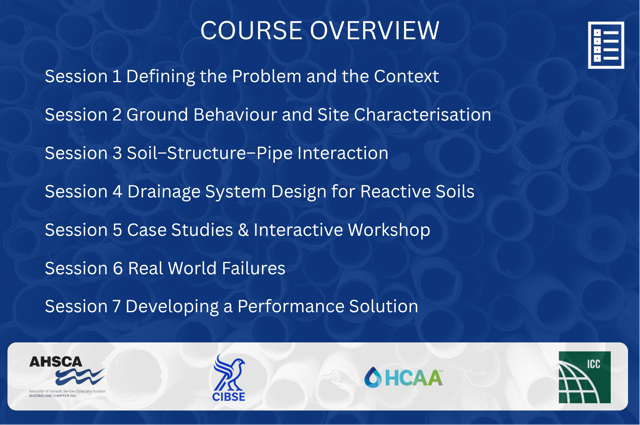
Session 1 Defining The Problem And The Context
- Course background and industry need – why consistent guidance is required for drainage design in reactive and unstable soils, and the gaps created by AS/NZS 3500.2 Appendix G being informative only.
- Legislative, code and standards framework – how the NCC (Vol. 3 / PCA) and the NZBC give effect to compliance, and the role of DTS Solutions versus Performance Solutions in Australia and New Zealand.
- Defining the problem – the three sources of difficulty: the ground (variable, time-dependent soil behaviour), people and data (siloed disciplines, incomplete reports), and the standards (fragmented, no performance criteria for buried pipes).
- Tools to solve the problem – the right people, the right questions, and the right data needed to design and verify drainage in challenging ground.
- Understanding geotechnical reports – distinguishing site classification from soil classification, interpreting key parameters (yₛ, Hₛ, soil suction), and knowing what a good geotech report should provide.
- Identifying the problem in practice – real-world red flags across site history, water conditions, soil behaviour, structural design, and documentation that signal reactive or unstable ground.
Session 2 Ground Behaviour and Site Characterisation
- Why drainage is sensitive to ground movement — pipes are stiff relative to soil, so most failures in reactive ground are movement-driven rather than hydraulic
- What "ground movement" means — vertical and lateral movement over time, driven by moisture change and almost always differential across short distances
- Primary drivers — seasonal and long-term wet/dry cycles, reactive clay shrink–swell, vegetation and irrigation, and cut/fill
- Reading the site — AS 2870 classification, the geotechnical report, and recognising where movement will concentrate (structural pipe–soil design follows in Session 3)
- Standards, monitoring and maintenance — AS/NZS 3500.2, AS 2870 and AS/NZS 2566.1, plus ongoing assessment through the asset life
Session 3 Soil–Structure–Pipe Interaction & AS/NZS 2566.1
- Pipe–soil as one system — how buried pipes and surrounding soil act together as a composite structure under AS/NZS 2566.1, sharing loads through soil support, deflection and load transfer.
- Flexible vs rigid behavior — why flexible pipes (PVC, HDPE) deflect and mobilise soil support while rigid pipes (concrete, clay) carry load structurally, and what this means for installation.
- Loads and load transfer — dead, live and ground-movement loads acting on pipes, and how soil arching and side support redirect load through the embedment zone.
- Embedment, bedding and haunching — the role of ring stiffness (SN), embedment materials, trench width, and why haunch compaction is the most critical zone for performance.
- Installation classes and quality — the four AS/NZS 2566.1 installation classes (A–D), Class A vs Class D outcomes, and how installation quality drives long-term integrity.
- Failure modes and design implications — settlement, deflection, joint strain and cracking; common installation risks; and why poor installation forces derating and redesign.
Session 4 Drainage System Design for Reactive Soils
- Historical context — how construction and drainage practice around reactive and unstable soils evolved from pre-1960s rule-of-thumb methods to the development of AS 2870.
- AS 2870 drainage principles — the key shifts AS 2870 introduced: a national soil classification system, drainage and moisture control integral to slab and footing performance, and risk-proofing measures such as clay plug barriers and flexible joints.
- Site and soil classification — how AS 2870 classifies soil reactivity (A through E) and site conditions, including P-class sites, and what that means for drainage design.
- Drainage requirements for reactive sites — Section 5.6.3 requirements, and how drainage design principles change for H1, H2 and E class sites.
- Methods of stopping moisture ingress under the slab — clay plug details, underground tanks, flexible connections, and protecting vertical risers and external branches.
- Practical detailing — stormwater, falls, below ground walls, and heavy duty DWV fittings — the day-to-day choices that determine whether a drainage design performs on reactive ground.
Session 5 Case Studies & Interactive Workshop
- Case Study 1 – Cut and Fill Scenario — a site straddling cut and fill ground, working through what risk-proofing and installation measures the drainage design needs to accommodate differential settlement across the boundary.
- Case Study 2 – Differential Settlement — a former floodplain site over soft, variable soil, examining what support and articulation measures a drainage design needs where footing and slab settlement varies across the building.
- Case Study 3 – Mine Subsidence — a P-class site at risk of mine subsidence on low-reactivity S-class soil, considering the risk-proofing measures needed to protect sanitary and stormwater pipework from a potential sinkhole or collapse.
- Case Study 4 – Deep Fill — a site with up to 18 metres of historical fill over a former ravine, working through why a standard deemed-to-satisfy installation failed and what should have been specified instead.
Session 6 Real World Failures
- Cracked Homes – A Current Affair (2011) — a real, high-profile media case of home damage from reactive soil movement, used to ground the session before working into the detailed failure examples.
- Pipe failures from lost or uneven soil support — a sequence of real installations showing how lost bedding support and differential settlement drive ovalisation, creep and stress cracking in flexible pipe materials.
- Loading and installation failures — clear-out and junction failures caused by vehicle loading, missing articulation at slab penetrations, and pipes installed without accounting for combined dead and live loads.
- Good vs bad soil and backfill practice — side-by-side real examples contrasting well-executed installations with poor soil conditions and backfill practice.
- Repairs in practice — real strapping and manhole chamber repair examples showing how these failures are remediated in the field.
- Uncontrolled vs controlled fill — a photographic comparison illustrating why fill control matters for long-term drainage performance.
Session 7 Developing a Performance Solution
- Purpose and framework — the training follows the process set out in NCC Clause A2G2, suitable for both simple and complex Performance Solutions, and requires stakeholders to collaborate and agree a design pathway.
- Prepare a Performance Based Design Brief (PBDB) — developed with key stakeholders — owners, builders, designers, and approval authorities — recording the agreed scope, assessment processes and acceptance criteria before design work begins.
- Carry out analysis — evaluating the design against agreed NCC Assessment Methods, using tools such as comparative or quantitative analysis, calculations, testing and modelling.
- Evaluate results — collating and assessing outcomes against the PBDB's agreed acceptance criteria, with further analysis or testing carried out if results fall short.
- Prepare a final report — demonstrating compliance with the NCC Performance Requirements, documenting the PBDB, assessment methods, assumptions and conclusions.
- Performance Solution Template
Meet the Trainers:
Chris Ferguson - Course facilitator

Chris is currently a Technical Specialist with Plastec Australia and brings more than 30 years of experience in the plumbing industry. He has managed the design and implementation of Plastec's range of articulated joints and risk-proofing technologies, contributing to innovative solutions for plumbing systems in challenging environments.
Chris has also played an active role in industry standards, participating in standards working groups and development committees. He travels extensively throughout Australia and New Zealand, working closely with geotechnical professionals, regulators, engineers, hydraulic consultants, and tradespeople to promote best practices in plumbing and construction for reactive and unstable ground conditions. In addition, Chris delivers professional training to TAFEs and industry groups, sharing his expertise in plumbing and drainage design for reactive and unstable soils.
Chris Taylor - Course facilitator
 After more than 40 years in the plumbing industry and nearly two decades in hydraulic consultancy, I found this training both practical and insightful. It reinforced key principles, challenged existing assumptions, and provided valuable guidance for designing, installing, and inspecting drainage systems in reactive soils. The trainers' knowledge and real-world experience were outstanding, making this a course I would highly recommend to anyone seeking best-practice outcomes.”
— Paul Lind, Hydraulic Consultant, South Australia
As a hydraulic consultant with over 25 years of industry experience, I found the Fundamentals of Drainage Design in Unstable Soils course to be exceptionally valuable. The course provided a strong technical foundation in soil behaviour, moisture management, surface and subsurface drainage design, and the interaction between drainage systems and foundation performance. The practical examples, case studies, and design principles reinforced best-practice approaches and offered insights that can be immediately applied to real-world projects involving unstable and reactive ground conditions.
— Adam Johnston, Hydraulic Designer, Verto, Tasmania
Course Contributors
